 |
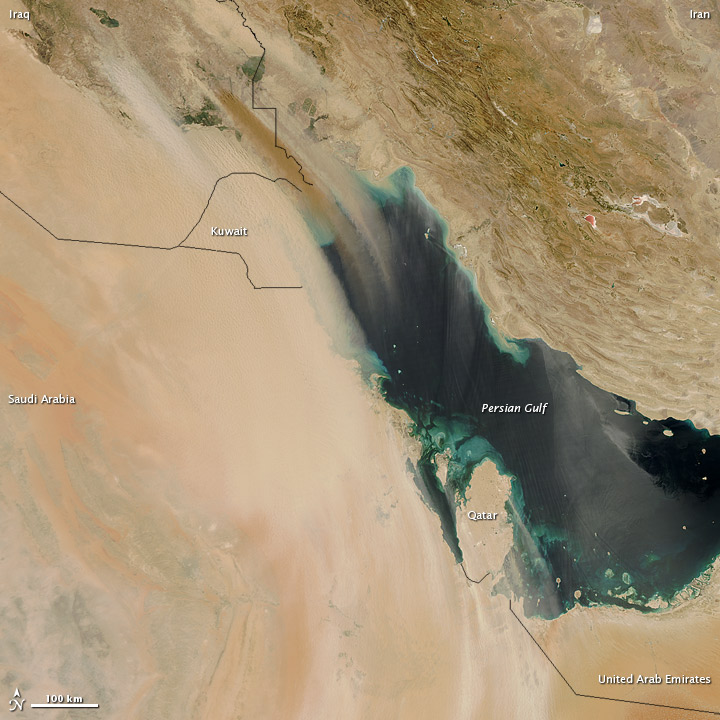
Image Courtesy: NASA Earth Observatory Instrument: Aqua - MODIS |
Dust Storm over the Persian Gulf
Image Courtesy: NASA Earth Observatory
Instrument: Aqua – MODIS
On June 2, 2012 (13 Khordad 1391), a dust storm swept across southwestern Iran. Winds carried soil particles toward the southeast and out over the Persian Gulf. This image, captured that same day by the Moderate Resolution Imaging Spectroradiometer (MODIS) aboard NASA’s Aqua satellite, shows the scene in natural colour.
Although we experienced clean, dust-free air in Shiraz, most parts of Khuzestan Province had a completely dust-filled sky that day, and daytime visibility fell to a remarkable 500 metres.
The most important reason for the intensification of dust storms in southwestern Iran in recent years has been the considerable increase in summer temperatures over central Iraq and the disturbances caused by the resulting atmospheric instability. These conditions ultimately generate strong surface winds and, consequently, dust storms downstream of the unstable regions.
The only benefit of a dust storm for areas affected by it is a relative reduction in temperature, caused by the decrease in the intensity of sunlight.