 |
| Image from the original article |
Larger version: see the original link preserved below.
Weather phenomena are described with terms such as storms, blizzards, low-pressure systems, tornadoes, derechos1, and many others. Tropical storms themselves are often named by the World Meteorological Organization and the U.S. National Hurricane Center. More recently, the media have even begun naming winter storms. [source] [source]
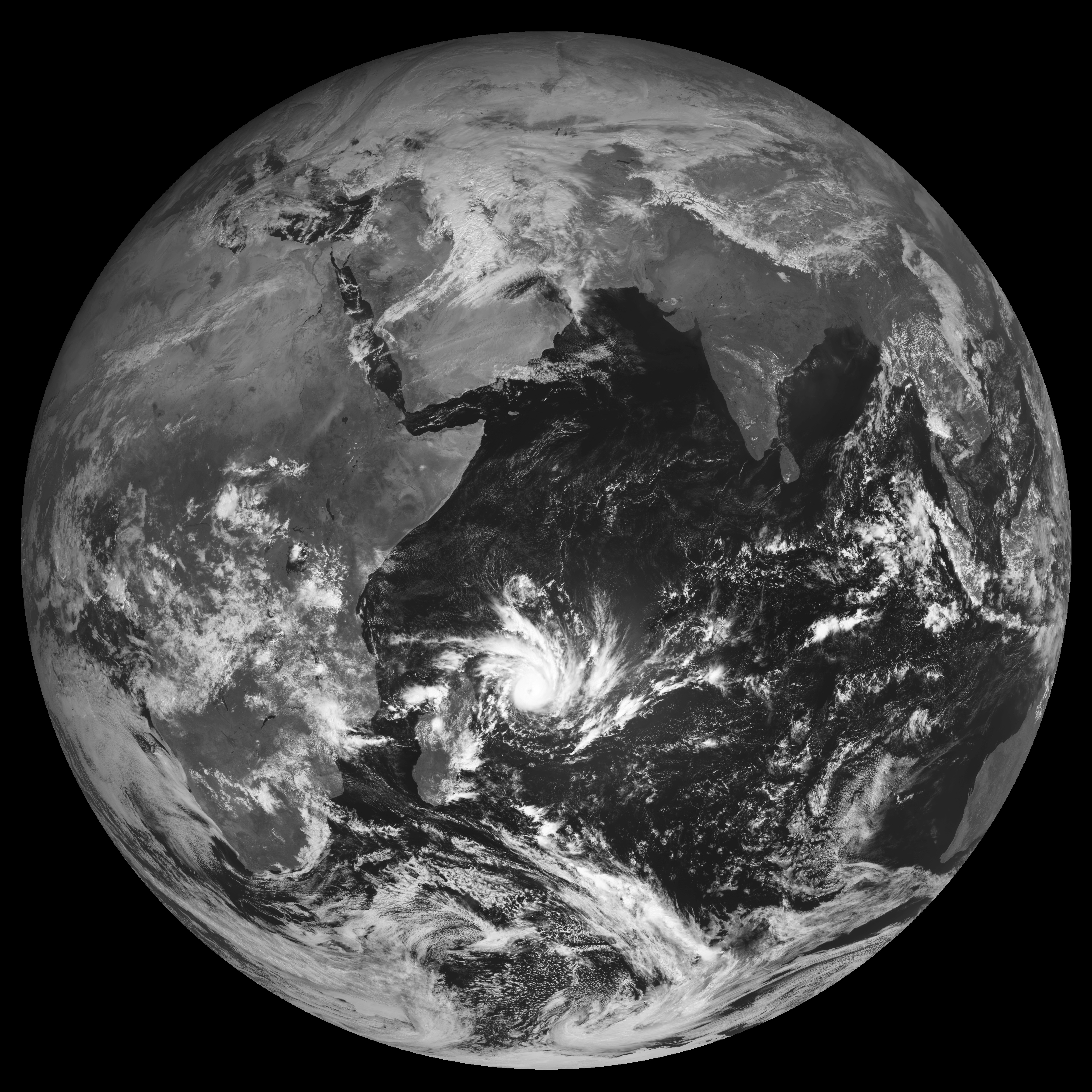
Meteorologists and climatologists use a simple method to classify storms. They divide them into three categories: thunderstorms, tropical storms, and extratropical storms. All arise from atmospheric disturbances and redistribute heat while producing different combinations of cloud types, precipitation, and winds ranging from light or moderate to severe. [source] [source]
The accompanying image, captured by a EUMETSAT satellite on January 29, 2013, simultaneously shows an example of all three storm types. Thunderstorms are the smallest, tropical storms are considerably larger, and extratropical storms are among the largest atmospheric systems.
In this satellite image, the mature clouds of the extratropical storm are extensive and comma-shaped. A mature tropical storm, by contrast, is spiral-shaped and often has a conspicuous eye at its centre. Thunderstorms have a more irregular form and consist of cumulonimbus clouds extending upward in a twisted structure. In satellite imagery, this characteristic structure gives the top of a thunderstorm a turbulent appearance. [source] [source] [source]
All three storm types require moisture, energy, wind, and particular conditions in order to develop, but the mixture of these ingredients varies according to the type of storm and the meteorological conditions where it forms. A thunderstorm, for example, develops when a trigger—such as a cold front—causes surface winds to converge, or when terrain destabilizes and lifts a warm, humid air mass. As the warm air rises it expands and cools; during this process, its relative moisture increases until water vapour condenses into liquid droplets and then ice crystals form in precipitation clouds. [source]
Tropical storms, commonly known as typhoons or hurricanes, occur when several thunderstorms organize into a larger system and circulate around a low-pressure centre, or storm eye. As such a storm moves across a warm ocean environment it becomes sustained and gains energy. The source gives a sea-surface temperature above 26.5°C as the threshold required for tropical-cyclone formation. These storms cannot develop, however, when wind shear2 is strong—that is, when surface winds and winds higher in the atmosphere differ greatly in speed and direction. [source]
Extratropical storms at middle latitudes can generate many kinds of weather, from light precipitation to severe blizzards and widespread storms. They normally begin at middle or higher latitudes. Whereas tropical storms obtain their energy from warm oceanic air masses in the tropics, extratropical storms derive their fuel and energy from interactions between air masses of differing temperature or humidity along their fronts. [source]
1 Derecho: a widespread straight-line windstorm resulting from intense convective activity.
2 Wind shear: a local change in the wind vector, or one of its components, along a specified direction.